
DELTATEC Technology aboard the IPERLITE Mission
At DELTATEC, we are proud to see our technology contributing to the IPERLITE mission, an initiative of the European Space Agency (ESA) under the GSTP program.
Our contribution includes a custom-designed hyperspectral camera that combines COTS and radiation-hardened components, capable of storing up to 1 TB of data. It also integrates an advanced onboard data handling system implementing, among other processing features, digital Time Delay Integration (TDI) up to 12 lines, significantly enhancing the instrument’s signal-to-noise ratio.
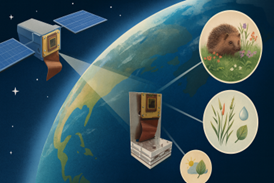
We are proud to team, under ESA’s leadership, with AMOS, IMEC, Aerospacelab, and VITO on this ambitious Belgian collaboration. While AMOS developed high-performance hyperspectral optics, designed for compactness and precision in Earth observation, IMEC provided its state-of-the-art thin-film interference filters, directly deposited on a 2D detector, enabling the capture of 154 spectral bands between 475 nm and 900 nm. AEROSPACELAB is hosting the payload on its VSP-150 satellite platform, offering flexibility and performance in orbit. Finally, VITO leads the Payload Data Ground Segment (PDGS), including the Ground Image Processing Facility and the Image Calibration and Validation Center, ensuring high-quality data processing and analysis.
Together, these efforts will validate the instrument’s performance in orbit and pave the way for new applications in agriculture, water quality monitoring, and environmental research.
If you wish to learn more about the mission or our camera technology, our team will be happy to connect with you.
NewSpace, industrialization: paradigm shift and necessary adaptation of Walloon ecosystems
AWEX: Space has changed a lot in recent years and continues to evolve. What is your corporate view of the sector?
EC: We see a major evolution: access to space is industrialising. Still partially public, but increasingly private. For a long time, space was the realm of agencies and (inter)national institutional missions. Today, private actors launch satellite constellations for commercial purposes. For us, this changes everything! Previously, demand was rather cyclical — depending on academic or institutional projects. Now, demand is becoming constant. Development needs are recurring, products are standardizing, cycles are accelerating — and ultimately, the return on investment is potentially faster.
AWEX: Is this shift good for business?
EC: For us — yes. We started our space-related activities in 2005. We combine solid industrial experience — in volume and efficiency — with institutional space experience, working with partners very demanding in terms of reliability. This dual expertise puts us in an ideal position today: we understand the needs of New Space actors while meeting the strict criteria of institutional missions.
This is a real revolution for the sector, and it is motivating for a company like ours.
AWEX: What is the place of Walloon companies in the international aerospace industry?
EC: It’s often not well known, but Wallonia has a complete space ecosystem. We have platform suppliers, companies specialized in optics, electronics, cryogenics, environmental test centers, as well as data-analysis experts. Together, the region covers all the skills needed to carry out a space mission from end to end.
That strengthens our credibility and visibility internationally, but also represents an asset for European technological sovereignty.
AWEX: Finally, you have a lot of export experience. What advice would you give to a company that wants to (re)develop its products for aerospace?
EC: The first advice I’d give is to emphasize experience. In space, clients look first at the technology readiness level (TRL). You need to show what has already been done, what has already been tested, and what has already flown. That is what creates credibility.
Second, highlight the sovereignty of your technology. Today, that matters a lot. “Made in Europe” is a strong argument on our continent, and remains for others a label of reliability and quality. For our part, we always favor European solutions — notably by avoiding ITAR-controlled components (from the United States) when a project requires it.
Finally, have a clear positioning. At DELTATEC, we focus our efforts on two axes: imaging and embedded data-processing systems. This specialization makes us visible and credible in a sector in full growth.
